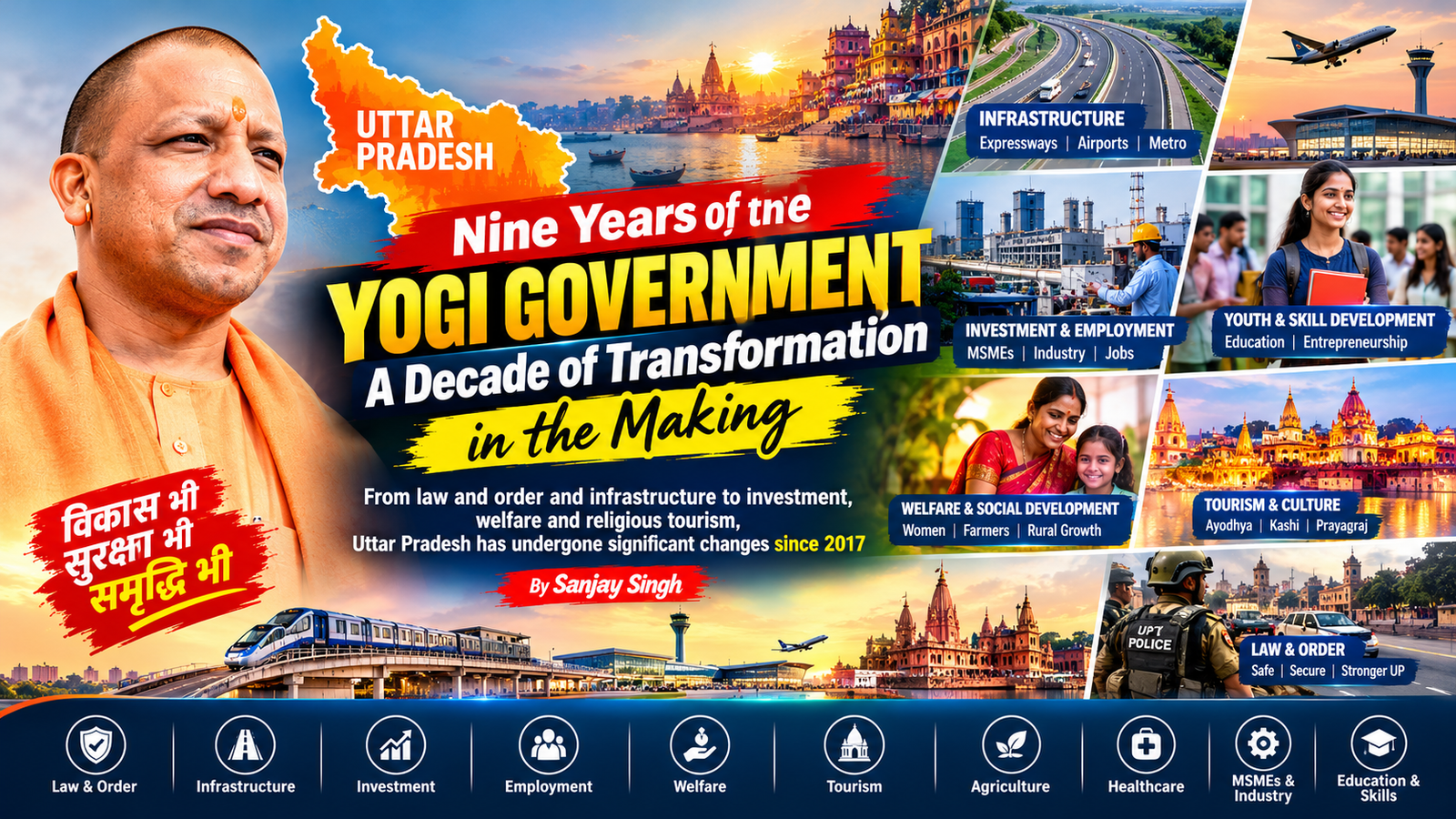
From law and order and infrastructure to investment, welfare and religious tourism, Uttar Pradesh has undergone significant changes since 2017
By Sanjay Singh
When Yogi Adityanath became Chief Minister of Uttar Pradesh on March 19, 2017, the state faced several longstanding challenges—law and order, inadequate infrastructure, unemployment, limited industrial investment and uneven delivery of public services.
Nine years later, the state government presents a very different picture of Uttar Pradesh. Its development strategy has focused on five broad areas: law and order, infrastructure and connectivity, investment and employment, welfare and social development, and tourism and cultural infrastructure.
The government’s nine-year achievement documents point to major expansion in expressways, airports, medical colleges, policing infrastructure, MSMEs, tourism and welfare programmes. At the same time, many of the headline figures are government-reported claims and should be read in that context. The larger question is how far these investments translate into sustained employment, higher incomes and better public services.
Law and Order: A Central Element of Governance
Law and order has been one of the defining priorities of the Yogi government. The administration adopted a stated policy of “zero tolerance” towards organised crime and illegal activities.
The government has strengthened policing through the commissionerate system, cybercrime infrastructure, forensic facilities and specialised security arrangements. According to the government’s March 2026 nine-year achievement document, seven police commissionerates have been established. The document also reports that the UP-112 emergency response time has come down to 6 minutes and 41 seconds.
Action against alleged mafia and organised-crime networks has included attachment and seizure of properties under applicable laws, including the Gangsters Act. The government has also expanded forensic capabilities and established the State Institute of Forensic Sciences.
These measures have changed the administration’s approach to policing. However, a complete assessment requires more than government claims. Crime registration, conviction rates, investigation quality, court outcomes, police accountability and human-rights safeguards are also important indicators.
Mission Shakti: Focus on Women’s Safety
Women’s safety and empowerment have received greater institutional attention through Mission Shakti, launched in Uttar Pradesh in 2020.
The programme brings together several initiatives, including the 1090 Women Power Line, women help desks, Safe City projects, CCTV surveillance, Pink Booths and women-focused policing. The Uttar Pradesh Police identifies Mission Shakti and the Safe City programme among the major initiatives of its Women and Child Security Organisation.
The state has also expanded social-support programmes for girls and women.
The Mukhyamantri Kanya Sumangala Yojana, launched in 2019, provides financial assistance in six stages—from the birth of a girl child through school education and entry into higher education. The present structure provides a total assistance of ₹25,000 in six stages: ₹5,000, ₹2,000, ₹3,000, ₹3,000, ₹5,000 and ₹7,000.
The Mukhyamantri Samuhik Vivah Yojana has also been expanded. Government records state that the assistance was increased from ₹35,000 to ₹51,000 and that 1.91 lakh couples had benefited by 2022.
The challenge now is to ensure that safety programmes are supported by effective investigation, prosecution, prevention and greater participation of women in education and the economy.
Expressways and Connectivity: Changing the Geography of Uttar Pradesh
Perhaps the most visible physical change in Uttar Pradesh has been the expansion of road connectivity.
The Agra-Lucknow Expressway, Purvanchal Expressway and Bundelkhand Expressway have created faster road links across different regions. The Ganga Expressway is adding another major east-west corridor.
According to the state government’s March 2026 achievement document, seven expressways were operational, with 15 more at various stages of development. The government also says Uttar Pradesh accounts for a major share of India’s expressway network.
The significance of these projects goes beyond reducing travel time. Expressways can support industrial corridors, logistics, warehousing, tourism and agricultural markets. Their long-term economic value, however, will depend on whether industrial and commercial activity develops along these corridors.
Airports and Urban Transport
Air connectivity has expanded rapidly.
Current state investment data lists 16 airports/airstrips, including five international airports, while several regional-connectivity projects are also being developed.
The Noida International Airport at Jewar has added a major new dimension to the state’s aviation and logistics strategy. The first phase was developed with an investment of about ₹11,200 crore and is planned as a major passenger and cargo gateway for the National Capital Region.
Metro and rapid-rail connectivity has also expanded. The government’s nine-year review lists metro services in seven cities—Lucknow, Kanpur, Agra, Noida, Greater Noida, Ghaziabad and Meerut. The Delhi-Meerut Namo Bharat corridor has added another important regional mobility link.
Together, these projects are gradually changing Uttar Pradesh from a primarily road-based transport economy into a more integrated road, rail and air network.
Investment, Industry and MSMEs
Attracting private investment has been another major objective since 2017.
The state has introduced investment and sector-specific policies covering manufacturing, electronics, defence, IT, data centres, logistics, textiles and other industries. Investment summits and the Global Investors Summit have been used to attract domestic and international investors.
The government’s March 2026 document reports investment proposals exceeding ₹50 lakh crore, with more than ₹15 lakh crore described as investments taking shape. It also reports more than 31,000 large industrial units and around 96 lakh MSME units in the state.
These figures need an important qualification. Investment proposals and memoranda of understanding do not necessarily mean that the entire proposed amount has actually been invested. The more meaningful indicators are projects completed, capital deployed, production generated and jobs created.
That distinction will become increasingly important as Uttar Pradesh seeks to move from investment announcements to measurable economic output.
One District, One Product: Taking Local Products to Wider Markets
The One District, One Product (ODOP) programme, launched in 2018, has become one of Uttar Pradesh’s most recognisable economic initiatives.
The basic idea is straightforward: identify the distinctive product or craft associated with each district and provide producers with support in training, finance, technology, branding, packaging and market access.
According to Invest UP, ODOP products accounted for more than half of the state’s exports by 2024, while more than 1.25 lakh toolkits had been distributed and loans exceeding ₹6,000 crore sanctioned under the programme.
The next phase, ODOP 2.0, is focusing more strongly on technology, quality standards, packaging, e-commerce and access to national and international markets. This shift is important because traditional products can become sustainable businesses only when they meet modern quality, design and market requirements.
The state’s Export Promotion Policy 2025–30 has set a target of increasing exports from $21 billion in FY2024 to $50 billion by 2030, with particular attention to MSMEs, start-ups, ODOP units and first-time exporters.
Farmers and Agriculture
Agriculture remains central to Uttar Pradesh’s economy, and the government has focused on irrigation, agricultural infrastructure, sugarcane payments, farmer welfare and rural connectivity.
The state’s nine-year achievement document reports that ₹3.15 lakh crore or more has been paid to sugarcane farmers, while the State Advised Price has increased from ₹315 to as much as ₹400 per quintal. It also reports that 3.12 crore farmers have benefited from PM-KISAN, with more than ₹99,000 crore transferred to their bank accounts.
The larger challenge is to raise farm incomes through diversification, food processing, cold chains, better market access and value addition rather than relying mainly on increases in procurement or administered prices.
Youth: From Job Seekers to Entrepreneurs
Employment remains one of the most important challenges for Uttar Pradesh because of its large and young population.
The government has responded through skill development, recruitment drives, competitive-examination coaching, digital-device distribution and entrepreneurship programmes.
Under the Mukhyamantri Abhyudaya Yojana, the 2026 state budget documents report that more than 23,000 young people were receiving free coaching through 163 operational centres. The government has also distributed nearly 49.86 lakh tablets and smartphones under the Swami Vivekanand Yuva Sashaktikaran Yojana.
The Mukhyamantri Yuva Udyami Vikas Abhiyan (MYUVA) represents a different approach—encouraging young people to become entrepreneurs rather than depending only on salaried employment. The scheme provides interest-free assistance for projects up to ₹5 lakh in its first phase and aims to support around one lakh young entrepreneurs annually.
The ultimate measure of these initiatives will be the number of sustainable enterprises created and the jobs they generate.
Healthcare: A Major Expansion of Medical Education
Healthcare infrastructure has witnessed one of the most significant expansions during the period.
The government’s earlier “One District, One Medical College” approach aimed to improve access to medical education and specialist healthcare across the state.
According to the Uttar Pradesh Budget 2026–27, the state now has 81 medical colleges—45 government and 36 private. Medical college facilities cover 60 districts, with plans for institutions in 16 currently underserved districts through the PPP model. MBBS seats in government and private institutions have risen by 12,800 from 4,540 in 2017, while postgraduate seats have increased from 1,221 to 4,995.
This expansion can improve access to doctors and medical education, but the next requirement is equally important: ensuring adequate faculty, nurses, equipment, medicines and affordable treatment so that infrastructure translates into quality healthcare.
Welfare and Rural Development
The government’s development strategy has also relied heavily on the delivery of central and state welfare programmes.
Schemes such as Pradhan Mantri Awas Yojana, Jal Jeevan Mission, SVAMITVA, sanitation programmes and rural electrification have been implemented alongside state initiatives.
SVAMITVA has particular significance for rural households because it seeks to provide property-related documentation to eligible residents through modern surveying and digital records.
Electricity supply, drinking water, rural roads and digital services have also expanded. The government has reported longer power-supply hours for district headquarters, tehsil headquarters and rural areas.
The important issue for the next phase is not merely coverage but reliability: regular electricity, functional water connections, quality roads and effective access to government services.
Religious Tourism: Ayodhya, Kashi and Prayagraj
Tourism has emerged as an important part of Uttar Pradesh’s development strategy, particularly around religious and cultural destinations.
The development of Ayodhya, the Kashi Vishwanath Dham Corridor in Varanasi, and permanent infrastructure associated with the Maha Kumbh in Prayagraj has substantially increased the scale of religious tourism infrastructure.
According to the government’s March 2026 document, more than 156 crore tourists visited Uttar Pradesh in 2025, while more than 66 crore devotees took a holy dip during the Maha Kumbh. These are government-reported figures and should be treated as such.
The economic impact of tourism extends beyond temples and pilgrimage sites. Hotels, restaurants, transport, handicrafts, local markets, guides and small businesses can all benefit when visitor numbers increase.
The challenge is to ensure that tourism growth is accompanied by better waste management, urban planning, public transport, heritage conservation and sustainable use of local resources.
Employment and Investment: The Numbers Behind the Transformation
The government’s nine-year achievement document reports more than 9 lakh government jobs and more than 3 crore employment opportunities in the private sector and MSMEs since 2017. It also reports investment proposals exceeding ₹50 lakh crore, with more than ₹15 lakh crore of investment taking shape.
These numbers are important indicators of the government’s stated achievements, but they should not be treated as equivalent measures.
A government job, a private-sector job, a self-employment opportunity and a temporary work opportunity are different forms of employment. Similarly, an investment proposal, an MoU, a project under implementation and an operational factory represent different stages of investment.
For a complete assessment, these claims need to be examined alongside employment surveys, investment data, factory production, labour-force participation and other independent datasets.
Nine Years: What Has Changed?
The Yogi Adityanath government’s nine years have brought a clear shift in the development priorities of Uttar Pradesh.
Law and order has been placed at the centre of governance.
Expressways, airports and urban transport have expanded connectivity.
ODOP and MSMEs have been positioned as engines of local enterprise and exports.
Medical colleges and healthcare infrastructure have expanded significantly.
Mission Shakti and welfare schemes have increased the focus on women and vulnerable households.
Youth entrepreneurship has been added to the traditional employment agenda.
And Ayodhya, Kashi and Prayagraj have become major components of the state’s tourism and cultural economy.
Yet the next phase will be more demanding.
The real test will be whether infrastructure generates productive economic activity, whether investment proposals become operational projects, whether employment growth produces stable and reasonably paid jobs, whether farmers receive higher and more sustainable incomes, and whether better policing is matched by strong investigation and judicial outcomes.
Similarly, the expansion of medical colleges will have to be matched by quality healthcare, while tourism growth will require better urban management and environmental sustainability.
After nine years, therefore, the story of Uttar Pradesh is no longer simply about announcing schemes or building infrastructure. The next stage is about converting infrastructure into productivity, investment into factories, skills into enterprises, and government programmes into measurable improvements in people’s lives.
That transition—from targets and projects to sustained outcomes—will shape the next chapter of Uttar Pradesh’s development story.